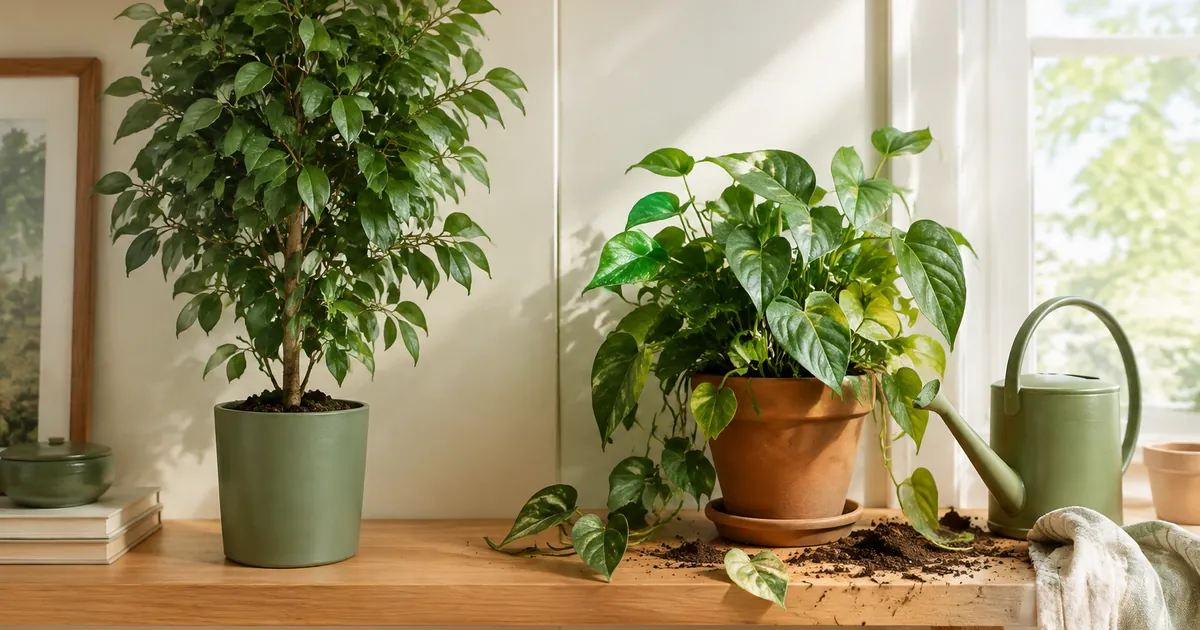
The honest selling point of an artificial tree is not "zero maintenance." It is ten minutes a month. Skip those ten minutes for a year and the tree develops the dull, gray cast that makes faux foliage obvious from across the room. Here is the routine that keeps them looking shop-new, plus the deep-clean methods for when it is too late.
The monthly ten minutes
Dust is the only real enemy. It settles on the top surfaces of leaves and needles, where it dulls the color and, under a lamp, becomes very visible.
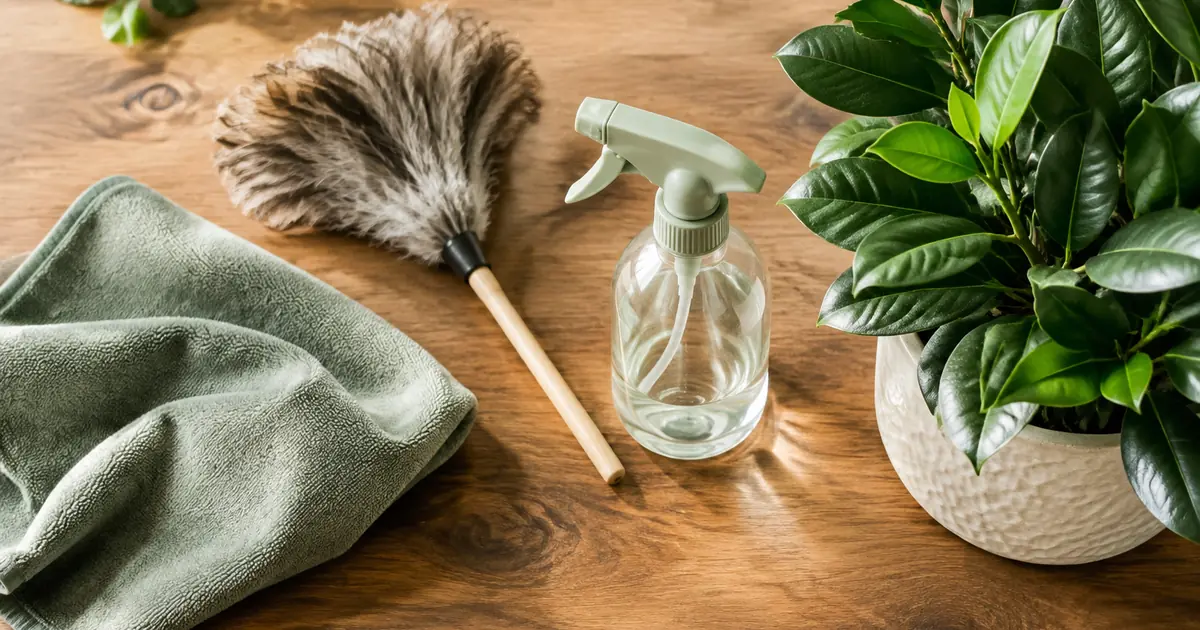
What you need
- A feather duster or a clean, soft paintbrush
- A microfiber cloth
- Optionally, a hair dryer on cool
The routine
Work from the top down. Sweep the duster along branch tops in the direction the foliage grows. For needle trees like the Norfolk pine, a cool hair dryer on low, aimed downward, blows dust out of dense spots a cloth cannot reach. Do this over the pot, not over carpet. Finish by wiping broad leaves, like the bird of paradise's, with the microfiber cloth, supporting each leaf from underneath.
The annual deep clean
Once a year, give the tree a real bath.
For most trees
Take it outside or into the shower. Use lukewarm water and a drop of dish soap, rinse gently, and let it drip-dry overnight. Keep water out of the pot's planting material; if the pot is not sealed inside, bag the base in a grocery bag and tie it at the trunk before washing.
For silk or delicate blooms
Do not wet them. Use the hair dryer on cool, then a pastry brush dipped in salt, brushed gently over petals; the salt picks up grime without crushing anything. This is the method for arrangements like our custom florals, where each bloom is wired by hand.
Protecting against fade
Indoors, fading is a non-issue behind normal window glass. On a covered porch, direct sun eventually lightens any fabric foliage. Two habits slow it down: rotate the tree a quarter turn every month so any fading evens out, and position it out of the afternoon sun belt. If a porch tree's color does soften after a couple of summers, a light wipe with a cloth barely dampened with a drop of olive oil restores the sheen on plastic foliage. Test on one hidden leaf first.
Reshaping after shipping or storage
Branches arrive, or wake up from storage, compressed. Shaping takes five minutes and makes more visual difference than any cleaning.
- Bend each branch gently at its base, fanning them out in a spiral rather than straight rows.
- Fluff needle foliage upward at the tips; real growth points up and out.
- Turn a few leaves on broad-leaf trees toward the main light source. Perfectly uniform leaf direction is the biggest tell of an unstyled faux tree.
Quick fixes for common problems
Leaves lost their shine
A microfiber cloth barely dampened with water, wiped across each broad leaf, brings back the sheen. For plastic foliage, a single drop of olive oil on the cloth adds luster; use it sparingly and never on fabric or silk blooms.
Branches sag after years
Internal wires fatigue, especially on heavy branches that were never reshaped after a move. Re-bend them to a slightly higher angle than you think you need; foliage weight will settle them back down. If a branch refuses to hold, a discreet florist's wire tied to the trunk solves it invisibly.
The pot looks tired
Pots scuff before trees wear out. Rather than replacing the tree, drop the nursery pot into a new decorative planter, or wrap the old pot in jute rope, secured with hot glue. Ten minutes and the base looks new.
Storage that prevents the crush
If you rotate seasonal trees, like a Norfolk pine that holidays on the porch, store it right: original box if the branches detach, or a garment bag in a dry closet if it does not. Never stack anything on top. Crushed branches from storage are the number one reason people replace trees that were perfectly good.
When to replace rather than clean
Care extends life, but nothing lasts forever. If the foliage has faded unevenly despite rotation, if wires no longer hold their bend, or if the trunk has cracked, the tree has served its years. The good news: a well-cared-for tree usually fails on one axis at a time, so a faded but sturdy tree can live on in a lower-light corner where fading never shows, while a new statement piece takes the bright spot.
The whole routine, summed up
Dust monthly, bathe yearly, rotate monthly on porches, reshape after every move, store upright and dry. That is the entire care manual, and it is why a tree bought once, like everything in our collection, looks the same years later.