An artificial tree is one of the few decor purchases you can make without thinking about watering schedules, sunlight or what happens when you travel for two weeks. But "no maintenance" does not mean "no thought." The right tree in the right spot looks like it grew there. The wrong one looks like it was dropped off by mistake. Here is how to get it right the first time.
Start with the height, not the style
Height is the decision that makes or breaks the room. A tree that is too short disappears against a standard 8-foot ceiling, and one that is too tall crowds the space.
Measure before you browse
Measure the floor-to-ceiling height of the spot, then subtract at least 12 inches. On an 8-foot ceiling, a tree between 5 and 6 feet tall sits comfortably. Our 5' Bird of Paradise Tree is built for exactly that range, while the Paradise Palm comes in 4', 5' and 6' options so you can size up or down.
Match height to function
Tabletop and entryway accents work at 2 to 3 feet. A Norfolk Pine in the 3' size fills a console or side table without blocking light. Corner fillers and sofa-side anchors want 5 to 6 feet. Anything taller starts competing with windows and art, so reserve those heights for two-story spaces or open floor plans.
Think about the footprint
Height gets the attention, but width decides whether the tree actually fits. A full, bushy Norfolk pine can spread 30 inches at its widest point. Check the diameter of the pot and the spread of the branches, then add a few inches of breathing room on every side. A tree jammed against a wall loses the silhouette that makes it convincing.
Let the room's light guide realism
This sounds backwards for a faux plant, but light affects how real an artificial tree looks. In a bright room, dense matte foliage like the Norfolk pine reads as true to life. In a dim hallway, glossy leaves such as the Bird of Paradise's catch whatever light exists and keep the corner from going flat. Rooms with strong afternoon sun flatter warm-toned foliage; north-facing rooms pair well with deeper greens.
Pick the pot like furniture
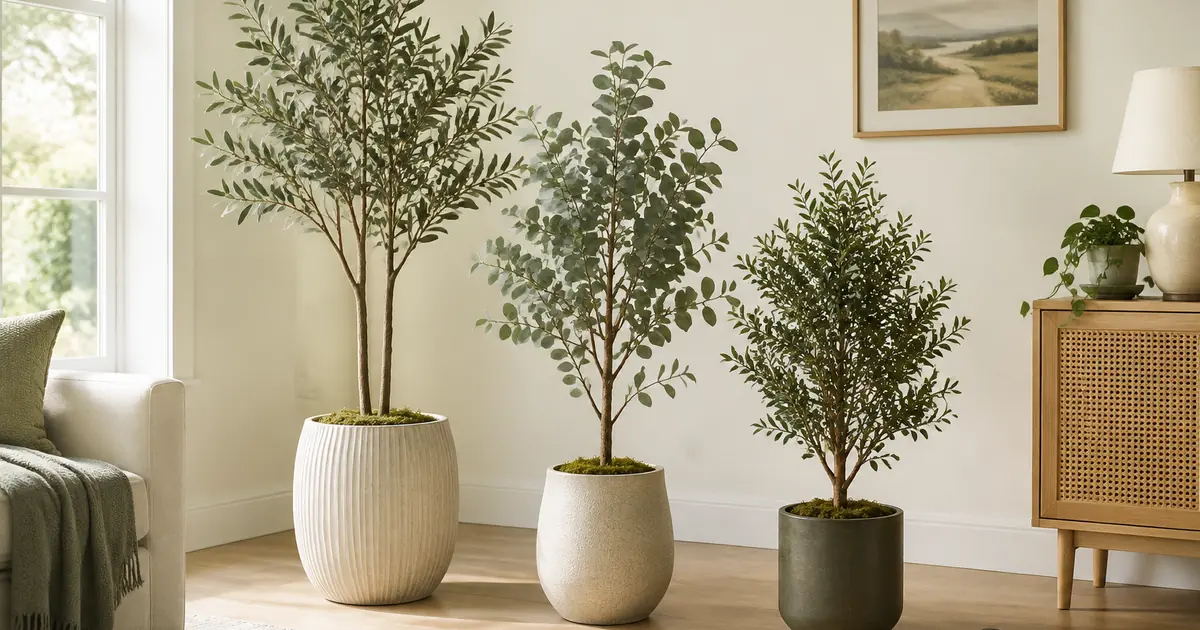
The planter is half the visual weight. A matte black pot disappears against dark floors and lets the foliage carry the look, which is why our Norfolk pine ships in one. Terracotta and woven baskets warm up a room with wood tones. If your space already has a lot of texture, choose a clean ceramic. If it feels spare, a basket adds the softness.
Match the species to the mood you want
- Calm and structured: Norfolk pine. Its layered branches bring order to busy rooms.
- Bold and tropical: Bougainvillea with orange blooms. One piece of color does the work of a whole shelf of accessories.
- Modern and architectural: Bird of Paradise. Big glossy leaves, strong vertical lines.
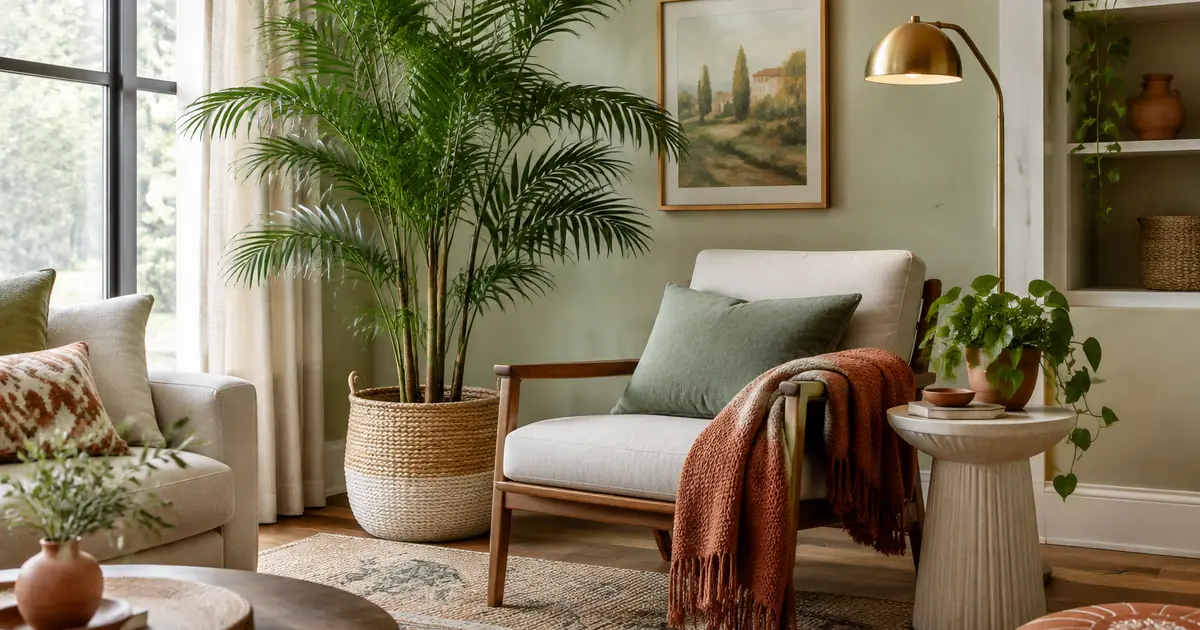
- Airy and casual: Paradise palm. Fine fronds soften hard-edged rooms.
Check the details that signal quality
Before ordering, look at close-up photos of the foliage. You want varied leaf sizes, some color variation between new growth and older branches, and a trunk with visible texture. Uniform, single-tone greenery is the fastest way to spot a cheap tree from across the room. Every tree we carry is chosen for those details, because they are what guests notice at second glance.
Budget: where the price actually differs
Two trees can look similar in a thumbnail and sit far apart in price. The difference hides in three places. First, foliage density: cheaper trees use fewer branches on a taller frame, which is why they photograph well from the front and disappoint from the side. Second, material mix: PE (polyethylene) leaves molded from real branches hold detail and bend without creasing, while thin PVC ribbons crush flat and shine under lamplight. Third, the trunk: real wood trunks cost more than plastic ones and look it, especially in the 5- to 6-foot sizes where the trunk is at eye level.
You do not need the most expensive tree in a category; you need the one that spends its budget on density and trunk rather than on a decorative pot you were going to replace anyway. That is also why our trees ship in simple, well-proportioned planters: the money is in the foliage.
One last question: where will it live?
Covered porches, sunrooms and living rooms all work. Uncovered outdoor spots with direct rain and wind do not, regardless of what any listing claims. If you are decorating a porch, keep the tree in a sheltered spot and it will hold up for years.
Ready to pick yours
Browse the full range of artificial trees and plants, measure your corner, and order the size that fits. If you want something sized or arranged for a specific spot, our custom arrangement service builds pieces for unusual corners and commercial spaces. Free shipping applies to every US order, Cash on Delivery is available at checkout, and every tree arrives shaped and ready to place.